
2026 World UAV Congress Forum Explores Low-Altitude Networks, Standards and Textbooks
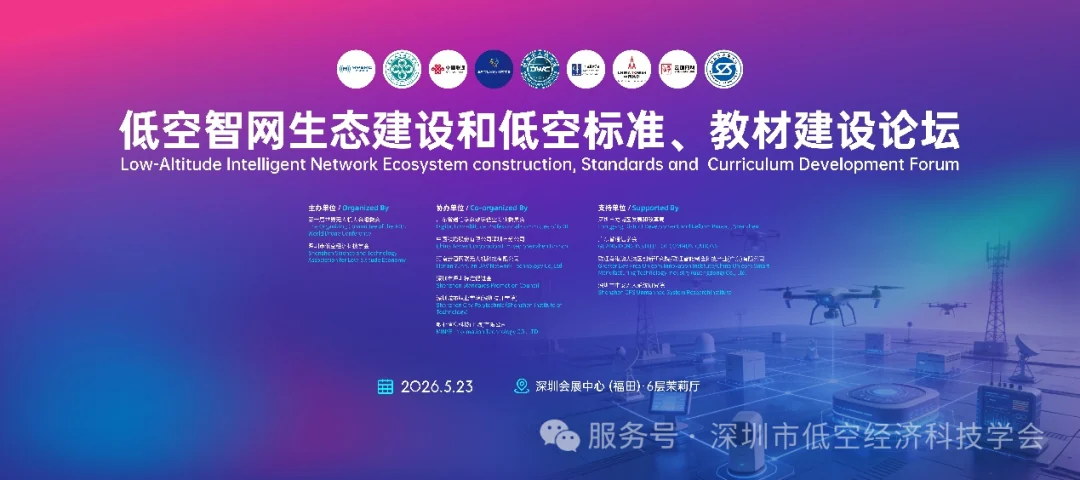
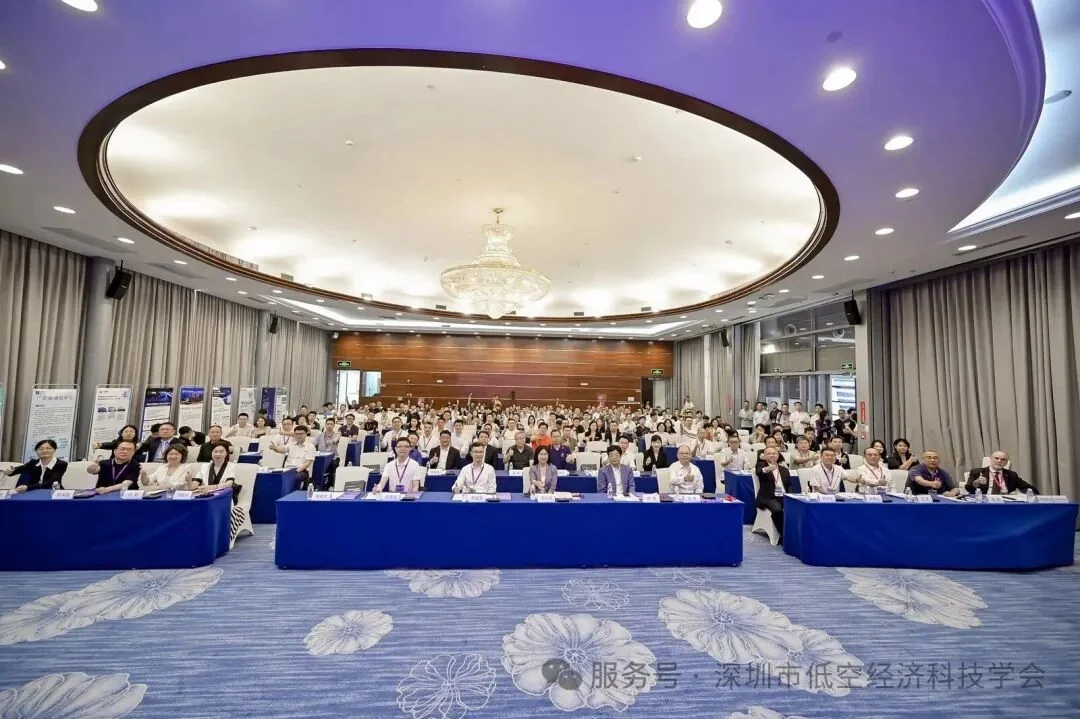
On May 23, 2026, a major supporting event of the 2026 10th World UAV Congress — the "Low-Altitude Intelligent Network Ecosystem Development and Low-Altitude Standards and Teaching Materials Development Forum" — was held in the Jasmine Hall of the Shenzhen Convention and Exhibition Center. The forum was jointly hosted by the Shenzhen Science and Technology Association for Low-altitude Economy and the Organising Committee of the 10th World UAV Congress, co-organised by the Digital Low-Altitude Professional Committee of the Guangdong Institute of Communications, China Tower Corporation Limited Shenzhen Branch, Henan Yunhuan Network-linked UAV Technology Co., Ltd., Shenzhen Standards Promotion Association, Shenzhen City Vocational College (Shenzhen Technician College), and Minye Information Technology (Shanghai) Co., Ltd., with supporting units including the Development and Reform Bureau of Longgang District, Shenzhen, and the Guangdong Institute of Communications.
Leaders, experts and entrepreneurs from government authorities, research institutions and universities, central enterprises and leading enterprises, and international industry organisations gathered together to work in close collaboration, conducting high-level discussions and in-depth exchanges on core topics such as the construction of the low-altitude intelligent network ecosystem, the development of the low-altitude standards system, the development of low-altitude professional teaching materials, and the cultivation of low-altitude industry talent, building consensus and pooling efforts for the standardised, large-scale and high-quality development of China's low-altitude economy.
I. Industry Priorities and Cooperation
The opening ceremony of the forum was moderated by Liu Zuxing, President of the Shenzhen Science and Technology Association for Low-altitude Economy. In the opening remarks, Liu noted that the low-altitude economy is an important representative of innovation-driven productivity and an emerging pillar industry. Shenzhen, as a national comprehensive demonstration zone for the low-altitude economy, is accelerating the large-scale implementation of "low-altitude +" scenarios, and networks, standards and talent are the key support for industry development.
Remarks by several distinguished guests opened the discussion for the forum:
Zhang Hongxia, Executive Vice Chair of the Guangdong Institute of Communications: In the opening year of the 14th Five-Year Plan, Guangdong is accelerating the construction of an integrated air-space-ground low-altitude intelligent network. She emphasized the need to consolidate the network foundation, focus on standards leadership, and strengthen talent cultivation, so as to build a solid foundation for the safe, standardised and sustainable development of the low-altitude economy. She stated that the Greater Bay Area has unique advantages for developing the low-altitude economy, and the Guangdong Institute of Communications will continue to play its role as a platform and bridge, working with all parties to promote the high-quality development of the low-altitude economy ecosystem.
Chen Mengchang, Deputy General Manager of China Unicom Guangdong Branch, stated that the take-off of the low-altitude economy requires the support of digital skyways and is a systematic project integrating communications, navigation, sensing, computing power and data. He released three action plans of China Unicom on site: opening up network capabilities, deepening technical verification, and jointly building practical training bases. China Unicom will consolidate the low-altitude digital foundation through joint technology research, joint standards development and joint talent cultivation, injecting strong momentum into the high-quality development of the national low-altitude economy.
Liu Li, Deputy Director of the Editorial Office of the Human Resources and Social Security Publishing Group, offered insights from the source of talent cultivation — teaching materials development — emphasizing that high-quality teaching materials are the cornerstone of talent cultivation. The Human Resources and Social Security Publishing Group has joined hands with the Shenzhen Low-Altitude Economy Association to launch the compilation of low-altitude professional teaching materials, establishing a joint development mechanism of "enterprise experts + research experts + institutional leaders" to promote the incorporation of job standards into teaching materials and the seamless connection between teaching and industry, so as to continuously supply practical talent for the low-altitude economy.
II. Technical Insights and Future Networks
Yu Baoguo, Director of the National Key Laboratory of Integrated Spatiotemporal Networks and Equipment Technology of the CETC Institute of Network and Communication, shared the technical pathway for the BeiDou integrated spatiotemporal network supporting the construction of the low-altitude intelligent network;
Kang Kang, Director of Low-Altitude Technology Research and Operations at the China Unicom Guangdong-Hong Kong-Macao Greater Bay Area Innovation Research Institute, elaborated on the approach to building low-altitude intelligent networks and the value of industry empowerment;
Yang Xun, Deputy General Manager of China Tower Shenzhen Branch, presented practical solutions for consolidating the digital foundation of low-altitude intelligent networks and supporting large-scale industrial implementation;
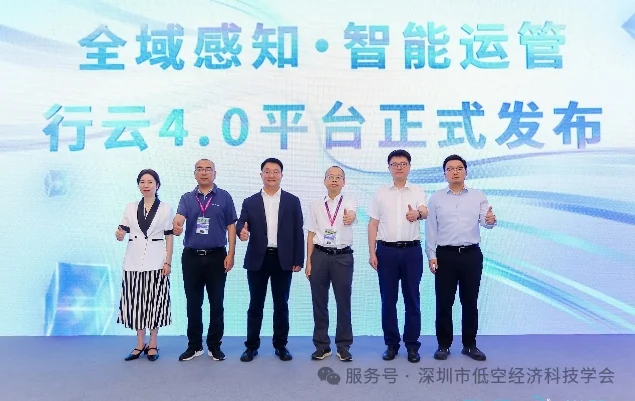
Han Henggang, Deputy General Manager of Henan Yunhuan Networked UAV Technology Co., Ltd., released the Xingyun 4.0 Low-Altitude All-Domain Perception Intelligent Operations and Management System, showcasing innovative achievements driven by both technology and products;
Li Jie, Professor at Xi'an Jiaotong University, delivered a presentation titled "Applications and Challenges of AI Vision in Low-Altitude Operations (《人工智能视觉技术在低空场景中的应用与挑战》)," analyzing the core applications and challenges of AI vision technology in low-altitude scenarios.
Huang Minchao, Chairman of Minye Information Technology (Shanghai) Co., Ltd., gave a presentation on low-altitude electromagnetic safety protection;
Wang Jianping, Director of the Science and Technology Promotion Department of the Shenzhen Science and Technology Association for Low-altitude Economy, introduced the Association's series of sci-tech innovation activities.
III. Service, Standards and Textbook Launches
The forum included launches and announcements covering industry networks, standards and workforce development.
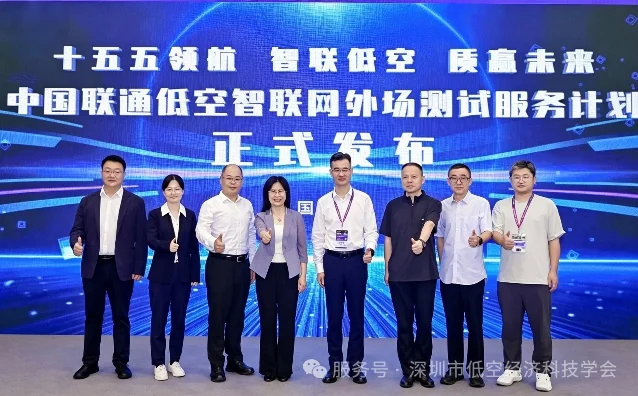
Launch Ceremony of China Unicom's Low-Altitude Intelligent Network Field Testing Service: This service not only provides an authoritative technical verification platform for low-altitude enterprises nationwide, but also marks that the Longgang Low-Altitude Intelligent Integration Test Base has entered a new stage of serving the industry and empowering the ecosystem.
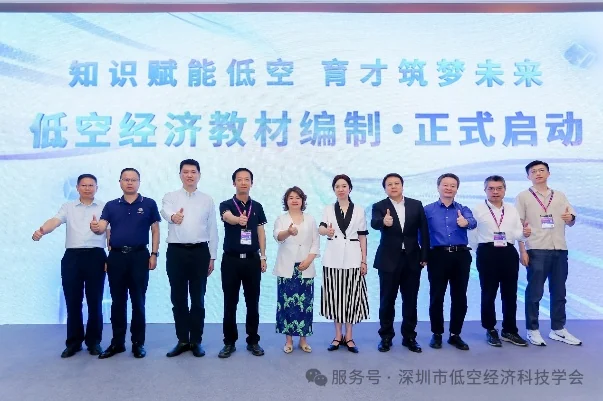
Official Launch of the Low-Altitude Economy Textbook Series: Commissioned by the Human Resources and Social Security Publishing Group and led by the Shenzhen Science and Technology Association for Low-altitude Economy, the compilation of two textbooks, Introduction to the Low-Altitude Economy (《低空经济概论》) and "Applications of Low-Altitude Communications and Navigation Technologies (《低空通信与导航技术应用》)," has officially commenced. The Association has joined forces with China Unicom Guangdong Branch, Xi'an Jiaotong University, Beijing University of Posts and Telecommunications, Shenzhen Pengcheng Technician College, South China Agricultural University, Global Eagle (Shenzhen) UAV Co., Ltd., City University of Hong Kong and other institutions to participate in textbook compilation and review. The Association will continue to recruit more outstanding universities and enterprises to join the compilation work.
The Association plans to work with universities, vocational colleges and industry partners on textbooks that combine theory with practical applications and align education with workforce needs.
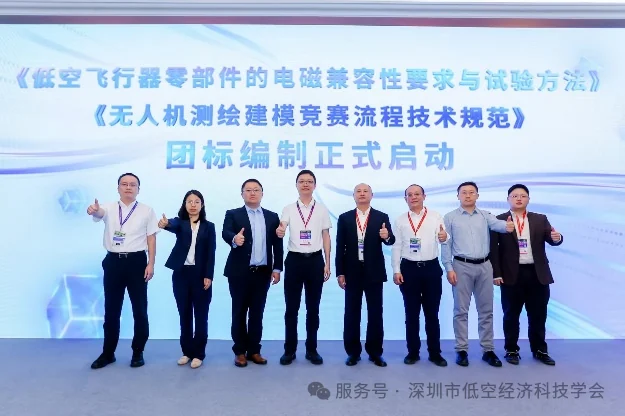
Compilation of Two Association Standards: Two association standards organised and compiled by the Shenzhen Science and Technology Association for Low-altitude Economy — Electromagnetic Compatibility Requirements and Test Methods for Low-Altitude Aircraft Components (《低空飞行器零部件的电磁兼容性要求与试验方法》) and Technical Specification for Drone Surveying and Modelling Competition Procedures (《无人机测绘建模竞赛流程技术规范》) — have been launched, and participating units are still being recruited. Electromagnetic compatibility issues will now have rules to follow, and related competition applications will become fairer and more standardised, injecting stronger momentum into high-quality development.
In addition, the association standard Guidelines for the Application of Unmanned Aircraft in Building Fire Inspection and Reconnaissance (《无人驾驶航空器建筑物消防巡查和侦察应用指南》) is inviting co-applicants as it moves towards inclusion in the GBA Standard list.
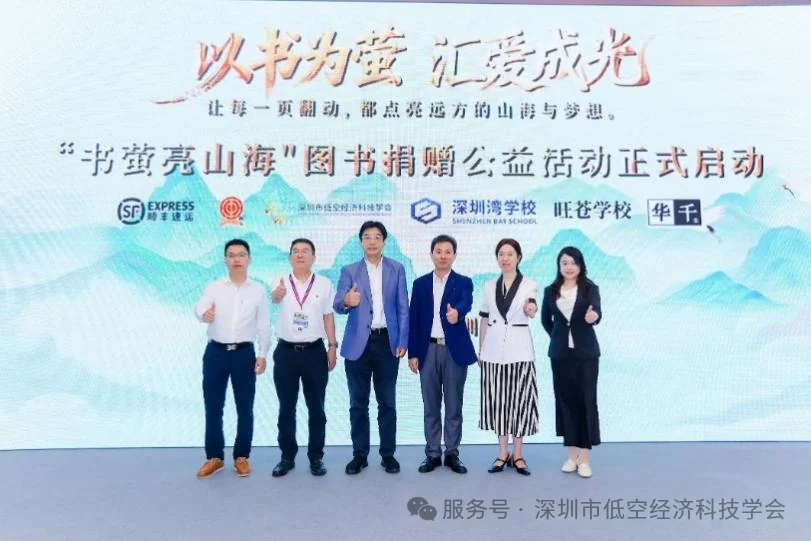
The Books Light Up Mountains and Seas reading initiative, hosted by Shenzhen Bay Middle School with support from the Association, the SF Holding trade union and Beijing Huaqian Online Network Co., Ltd., supports primary schools in disadvantaged areas through shared reading activities.
Henan Yunhuan Network-Linked UAV Technology Co., Ltd. launched Xingyun 4.0, a low-altitude monitoring and operations management platform using the Internet of Things, AI and big data. The platform is designed to support larger-scale low-altitude applications and urban airspace management.
IV. Roundtable Discussion: Tackling Talent and Ecosystem Challenges
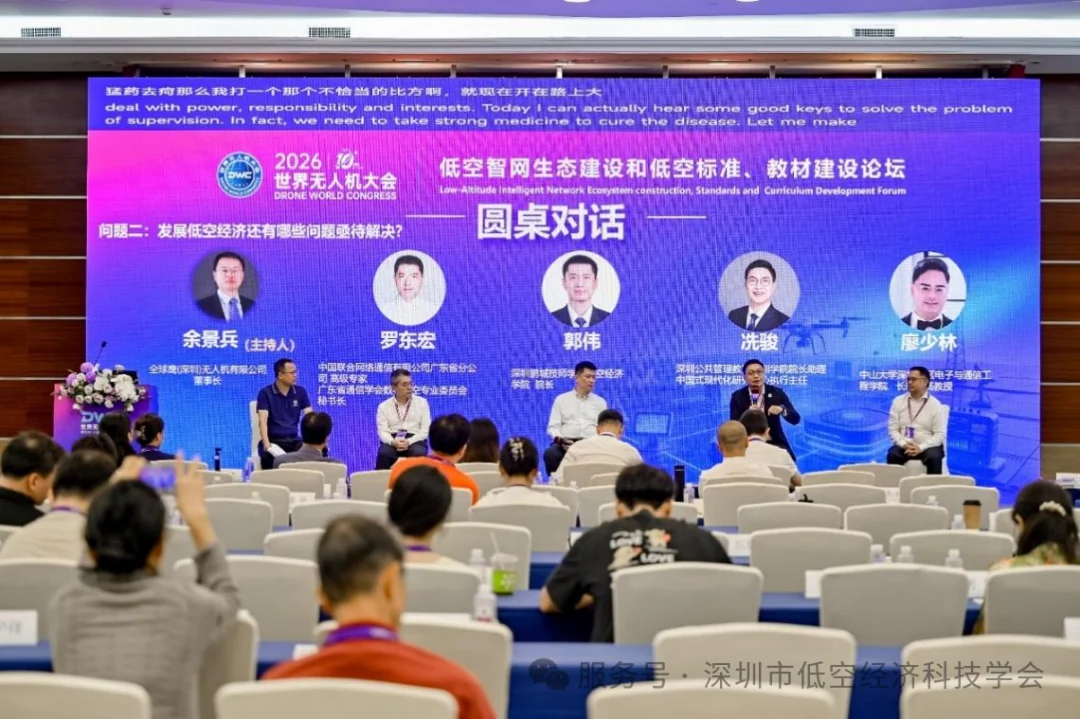
Yu Jingbing, Chairman of Global Eagle (Shenzhen) UAV Co., Ltd., moderated the closing roundtable. Participants included Luo Donghong of the Guangdong Unicom 5G Innovation Laboratory and the Digital Low-Altitude Committee of the Guangdong Institute of Communications; Guo Wei, Dean of the School of Low-Altitude Economy at Shenzhen Pengcheng Technician College; Xian Jun of Shenzhen Public Management Education and Training College and its Research Centre for Chinese-Style Modernisation; and Liao Shaolin, a tenured professor at Sun Yat-sen University. The discussion covered workforce development and urgent industry challenges.
Participants highlighted skills shortages across research, piloting, infrastructure, regulation, operations and safety, including a need for specialists who can work across disciplines. They called for clearer implementation of policy, more practical applications, viable business models and stronger safety systems. AI-driven electromagnetics was identified as a priority for addressing complex low-altitude electromagnetic environments.
V. Forum Outcomes and Next Steps
The forum attracted more than 400 participants from China and abroad. Attendees welcomed its combination of strategic discussion and practical industry experience.
Some audience members said that this forum was not only a high-level academic and industry exchange event in the low-altitude economy field, but also a pragmatic conference that built consensus, promoted cooperation and clarified pathways. It injected new strong momentum into Shenzhen's efforts to build itself into the "No. 1 City for the Low-Altitude Economy" and into the high-quality development of the low-altitude economy nationwide.
Thanks to the Forum Supporting Organisations:
Development and Reform Bureau of Longgang District, Shenzhen
Guangdong Institute of Communications
Unicom Guangdong-Hong Kong-Macao Greater Bay Area Innovation Research Institute
Unicom Intelligent Manufacturing Technology Industry (Guangdong) Co., Ltd.
Shenzhen Zhong'an Unmanned Systems Research Institute
Shenzhen Science and Technology Association for Low-altitude Economy
May 23, 2026